A First Letter
Dear Richmond Hill,
This is my first letter to you, so perhaps I should begin by introducing myself, even though, after more than two decades here, we are hardly strangers.
I did not set out to become someone who writes about zoning, municipal finances, transportation networks or the condition of sidewalks. Like most people, I became interested in these subjects because something happened in my own life.
At the height of the COVID pandemic, I had to leave what had been our family home and find somewhere else to live. I had a job. I had an income. And yet the experience taught me how frighteningly close an ordinary person can come to not having a secure place to call home.
That sent me looking for answers.
There was no shortage of explanations for the housing crisis. Foreign buyers were blamed. Developers were blamed. Municipal zoning was blamed. Density was blamed—sometimes for being too high and sometimes for being too low.
Then, late one night, I came across Strong Towns. Its basic argument made immediate sense to me: the way we build our communities has consequences. Streets, pipes, subdivisions and parking lots are not merely things that appear on the landscape. They come with bills—bills that eventually arrive at City Hall and, not long after, in our mailboxes.
That discovery led me out into the community to talk with other Richmond Hill residents. A year and a half later, close to 100 people receive our STRH newsletters, and hundreds more visit the website.
That is enough about me for one letter. Let us turn to Richmond Hill.
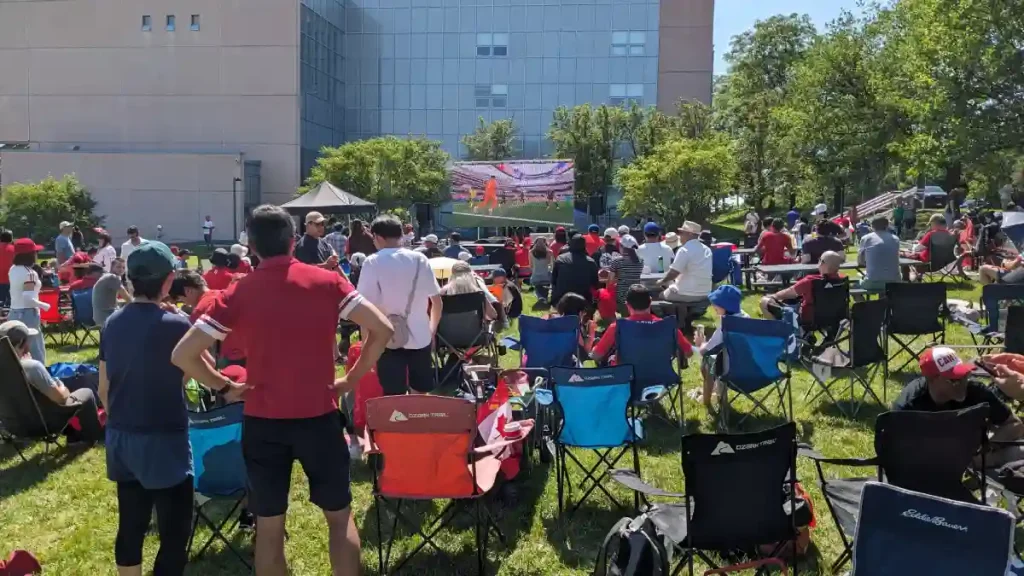
FIFA World Cup watch party at the Dave Barrow Square
After several years of ignoring football—I refuse to call it “soccer”—this summer I jumped back on the bandwagon and started watching the games. How could I not, living with three die-hard Argentina fans?
The World Cup felt different this time. Canada was one of the host countries, and several matches were played in Toronto, practically on Richmond Hill’s doorstep.
Canada gave us something to celebrate, too. The team reached the knockout stage for the first time, defeated South Africa and eventually lost to Morocco in the round of 16.
But something else worthwhile happened here during the tournament: Richmond Hill hosted public watch parties, and people came. [read more]
I watched Canada play South Africa at the Richmond Hill Public Library’s watch party, and we all jumped for joy when Canada won. The turnout showed that our city can create its own shared experiences. We do not always have to travel to downtown Toronto to feel part of something larger.
For a few hours, people who might normally pass one another in cars stood together, watched together and cheered together. On our way home, drivers who saw us returning from the watch party honked their horns in celebration.
It felt as though Richmond Hill had won something too.
The good news is that the City has now broken ground on a permanent gathering place beside the Central Library: Dave Barrow Civic Square. The square is intended to host events, celebrations and everyday gatherings throughout the year while acting as a gateway to Richmond Hill’s historic Village area.
It will give residents a place to gather, celebrate, be entertained, protest or simply spend time together. And perhaps the best part is its location beside downtown, where that activity can contribute to the life of the surrounding area.
I lived in London, England, for a while. Many neighbourhoods there seemed to revolve around a “high street,” where shops, cafés, restaurants and daily life came together. Not every high street was closed to cars, of course, but the best ones made it easy to walk, browse the storefronts and stay for a while.
I have a dream that one day—hopefully in my lifetime—our downtown will feel like that.
I imagine some of the asphalt replaced with paving stones, with benches, tables and trees along the street. People could walk between the shops, look into the windows, meet someone they know or sit down without the constant noise and pressure of traffic.
Not too far away, Toronto is already experimenting with something similar. A section of Church Street between Wellesley Street East and Alexander Street has been closed to motor vehicles from June 19 to August 21 as part of a pedestrianization pilot.
The idea of getting around the city without driving may sound unimaginable. But I assure you that it is possible because I have lived that way for more than two decades in Richmond Hill.
Even on bitterly cold winter mornings, I have walked through knee-deep snow to reach the bus stop. And, not surprisingly, I was often more likely to arrive at work on time than some of the people who drove.
Some might think I was trying to prove a point by living this way.
Absolutely not.
It was not a pretentious lifestyle gesture. I simply found that I did not need to own a car. But I am certain that if Richmond Hill and its streets were designed more for people and less exclusively for automobiles, getting around would be much easier for those of us who do not drive.
We may not want to change the design of our city to accommodate different ways of living. But sooner or later, we will discover that we need to change because we cannot afford the long-term liabilities created by our current way of building [read our article on this].
Sometimes the unrealistic idea is not a downtown with fewer cars.
It is believing that we can continue building everything around the car forever—and always afford the bills.
Around Richmond Hill

A few other things happening around our city:
Krasman Centre moves—temporarily—to Essex Avenue
After leaving its longtime downtown location, the Krasman Centre has opened an interim Richmond Hill drop-in centre at 145 Essex Avenue, near Major Mackenzie Drive.
The move into a residential neighbourhood has generated concerns and discussion among nearby residents on Reddit and Nextdoor. Those concerns should be heard, but the conversation should also remain grounded in facts.
Krasman is a peer-run centre that provides support and practical resources for people experiencing mental-health, substance-use, housing and homelessness challenges. The Essex Avenue location is described by the centre as temporary while it searches for a permanent home.
A data centre for Richmond Hill?
Council is considering a project that may consume considerable land and electricity while creating relatively few permanent jobs.
It raises an important question: should every major development be welcomed simply because it promises investment?
We must become better at distinguishing between development that strengthens Richmond Hill and development that merely adds something large to the map.
A drop in the bucket—with strings attached
Ontario has awarded Richmond Hill $5.94 million through its Building Faster Fund after the city recorded 2,228 housing starts in 2025—83 per cent of its provincial target. The money is intended for housing and community infrastructure.
Nearly $6 million is certainly useful. But it sounds much larger at a podium than it does when placed beside the long-term cost of building and maintaining a city.
It is a reward, not a financial rescue plan.
Urban Behaviour comes to the suburbs
When I saw the name of the retailer replacing Hudson’s Bay at Hillcrest Mall, the first thing that came to mind was the concern expressed by some residents whenever change is proposed:
“No, Richmond Hill is a suburb. We don’t want to change it, and we certainly don’t need the bad influence of urban behaviour!”
Well, Urban Behavior has arrived anyway—although, in this case, it is simply another discount fashion retailer occupying the former Bay space.
And, of course, another inexpensive fast-fashion store was exactly what Richmond Hill was missing.
Worth Your Time
Here are a couple of stories from beyond Richmond Hill that connect to our ongoing Strong Towns conversation:
Six in the morning?
Richmond Hill is not exactly known for its nightlife. Many places are dark by early evening—even if I may be exaggerating slightly when I say everything closes at six.
Toronto, meanwhile, is considering a much later night.
To be precise, the city is not proposing that every bar remain open until 6 a.m. A Toronto councillor has asked staff to study a Montreal-style “nightlife hub” model that could allow selected venues to stay open until 6 a.m. during approved events. It is still only a proposal.
The larger question is not simply how late alcohol should be served. It is what makes a city feel alive after dark—and how cities can support nightlife while respecting the people who live nearby.
Small homes, big difference
When a couple begins its life together—or when empty nesters no longer need a large house—they may want a home that fits their new reality.
Such places are often called “tiny homes,” but I have never particularly liked that expression. “Tiny” can suggest something inadequate, when a smaller home may be exactly the right size for the person living in it.
The Shalom Small Homes project in Kemptville has completed four affordable, independent homes for low-income seniors and is raising money to build another 16. One resident had moved 28 times over nearly two decades before finally finding stability there.
For the people living in them, these homes are not tiny.
They are secure, affordable and dignified.
Walking Away Thinking…
This is the quiet part of summer, when many people are travelling, spending time with family or simply trying not to think about politics.
That is understandable.
But by the time the summer vacations end, Richmond Hill will be moving quickly toward a municipal election. I hope we return ready to look beyond campaign signs and slogans and ask a more useful question:
Which choices will leave Richmond Hill stronger, more affordable and more connected ten or twenty years from now?
That question runs through almost everything in this first letter—from civic squares and high streets to smaller homes, transportation choices and municipal infrastructure.
What we build shapes how we live. It also determines what future residents will have to pay to maintain.
I will be here, continuing to ask that question and advocating for a stronger Richmond Hill.
Until the next letter,

💬 What do you think? Join the conversation on STRH Feed
STRH Feed is our community discussion space. Click through to see what others are saying and add your voice.